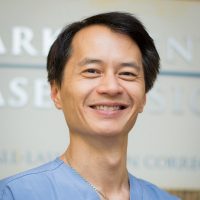

Dear PATIENT NAME
You have a history of Keratoconus(KC).
Your visit is on: DAY OF WEEK, MONTH, DATE, TIME AM/PM.
We’re located at 102 E 25th Street & the SE corner of Park Avenue South, Ground Floor.Generally, we prefer the KC patients to come on Thursday afternoons, because that’s when both of our eye surgeons are in: Dr Chynn, the owner, & Dr Dovzhuk, his assistant.
We accept all major medical insurances except Medicaid. Our medical biller, Sandra is included here, and will say if your insurance covers CXL, and if a Prior Authorization will be necessary.
If so, you must work carefully with Sandra & Dr Dovzhuk to obtain thisDr Chynn was one of the few eye surgeons in the country who was performing CXL even before FDA approval, as an investigator under an Independent Review Board. So he has been performing CXL longer than almost every other eye surgeon in the TriState area
Dr Dovzhuk is from Ukraine, and there she assisted on over 1,000 CXL procedures. She assists Dr Chynn on all his CXL procedures, so when you get your CXL with us, you’ll have two surgeons, to ensure optimum results
Most corneal specialists in the US perform only CXL on their KC patients, because they perform LASIK or Smile, and it’s unsafe to cut into an already thin, weak KC cornea (LASIK requires 1 cut; Smile requires 2).
Unfortunately, if you get only CXL, you won’t see better, because that’s not the purpose of CXL. CXL is merely designed to strengthen your cornea so it doesn’t bulge out more, to prevent the need for a corneal transplantDr Chynn has performed more LASEK surgeries than any other surgeon in the US, because he helped invent that procedure when he was at Harvard. So he has more experience than any other surgeon in the US in whether it’s safe to add LASEK to your CXL
Unfortunately, by the time an optometrist or non-corneal general ophthalmologist refers a KC patient to us, they’ve often been in scleral lenses for years, only slow down, but do not stop the progression of keratoconus. If you have advanced KC & your cornea is very thin, it’s unsafe to add LASEK to your CXL, so you’ll get only CXL to strengthen your cornea & stop disease progression
Fortunately, in the majority of cases, the KC patients we see have enough cornea so it’s safe to add LASEK to your CXL. LASEK will eliminate most of your astigmatism and much of your myopia, so you’ll see much better after your combined procedure.
Of our last 100 eyes treated with CXL + LASEK, 100% had visual improvement, seeing 1-7 lines lower on the eye chart (eg going from 20/400=legally blind to 20/50=legal to drive). 69% had their astigmatism reduced sufficiently that they were able to stop wearing scleral lenses, and return to more comfortable/affordable soft toric lenses. 49% saw so much better that they became legal to drive in the daytime without glasses or contacts (20/50). 100% said if they had to do it over again, they would. 0% had disease progression leading to needing a cornea transplant. 9% did need repeat CXL 1-3 years later because of minor progression (we perform 2nd CXLs for free). This emphasizes the need to return for exams every 6 months for 3 years, and every year for the rest of your life, to be safe
Park Avenue LASEK is the only center in the TriState region with a 3rd generation CXL device that’s more powerful than other devices, so the UV light exposure is only 3 minutes, rather than 30 minutes for 2nd generation devices. Dr Chynn also developed a way to apply the liquid riboflavin to your eye that’s much more effective, so it takes 7 minutes, not 30 minutes like at other centers. So your entire CXL treatment will take 10 minutes, vs 1 hour at other centers—that’s 1 hour either way a clamp holding each eye open, which is painful
Please bring in a copy of your last few eye exams for Dr Chynn to review, or email them to [email protected]. Some insurance companies require evidence of disease progression before they’ll pay for CXL, so this is important. If you need help doing this, please ask us for help on
Reply with a photo of the front and back of your medical insurance card so our medical biller Sandra can confirm that it’ll pay for your CXL. If you’re uninsured, we charge $500 for Dr Chynn to review your records, examine your eyes, and give you his expert opinion
We’re the only center in NY who will let you speak with a happy ex-patient who had CXL or CXL+LASEK. Please remind us to add this “buddy” to your WhatsApp group, to facilitate this communication
Also bring your now & old glasses, contacts, contact lens prescriptions & any eye medications you’ve been prescribed or are currently taking for Dr Chynn to review
LASEK is considered cosmetic so will not be covered by your insurance. But we offer 0% interest financing with $0 down, and you can pay as little as $100/month
If you need to reschedule, please CALL (212) 741-8628. Please don’t just “no show” as that’s extremely disrespectful, & wastes a lot of our time and money, so Dr Chynn might not agree to allow you to rebook
Looking forward to treating your KC so see better and have a new, better life
Park Avenue LASEK &
Emil Chynn, MD, FACS, MBA
Dartmouth + Columbia + Harvard + Emory + NYU


This page contains the same patient instructions our office provides before a consultation. These instructions explain what records to bring, how insurance may apply to CXL, what to expect during the evaluation, and how combined CXL + LASEK may benefit certain patients.
If you have been told you are not a candidate for LASIK because of thin corneas or keratoconus, a consultation may help determine whether other treatment options exist.