
Crosslinking

Stop Keratoconus. See Better.

The only center in New York that combines Crosslinking + LASEK for eligible patients.​

Why Keratoconus Patients Choose Park Avenue LASEK

Most eye centers perform crosslinking to stabilize the cornea.

Most laser centers perform LASIK or SMILE, which are generally not appropriate for keratoconus.

Park Avenue LASEK is unique because we can evaluate whether you are a candidate for Crosslinking PLUS LASEK, helping many patients not only stop progression, but also improve vision.

If your cornea is too thin or advanced, we’ll tell you honestly and recommend CXL alone.

If you’re a candidate for both procedures, we can discuss a treatment plan designed to strengthen your cornea while reducing nearsightedness and astigmatism.

Dr Chynn on duty 2

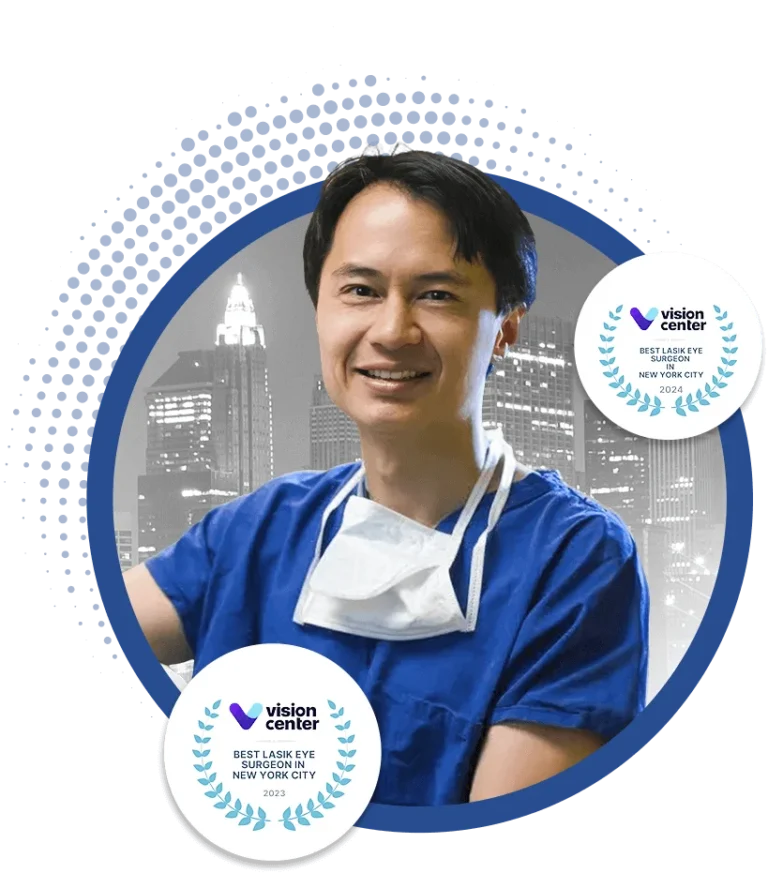
Dr. Chynn & Park Avenue
LASEK & CXL

Dr. Chynn and Park Avenue LASEK have been performing CXL/KXL under IRB (Institutional Review Board) supervision for several years. We have more years of experience than almost every other center, private or hospital-based/university, and more patients treated, as well.
Dr Chynn on duty 2

CORNEAL CROSSLINKING (CXL) in New York, NY

Corneal crosslinking (CXL) was developed in 1998 by Theo Seiler, MD (whom Dr. Chynn knows) and has been shown in numerous clinical trials to strengthen the cornea to treat conditions such as:
Riboflavin, a form of vitamin-B2, is applied to the cornea in the form of drops, followed by treatment with ultraviolet A (UV-A) light, which adds crosslinks to the cornea collagen, much like rebar is added to concrete to make it stronger. This safe treatment, which has been recently approved by the FDA, so medical insurance is starting to cover it, can slow or even stop the progression of keratoconus, PMD, or ectasia after the cutting LASIK procedure (ectasia after PRK/ LASEK is much less common because those procedures are non-cutting).

Hear from Patients that SEE BETTER after Crosslinking with LASEK at the only center that does both

Office Patient Instructions

Below contains the same patient instructions our office provides before a CXL & LASEK visit. These instructions explain what records to bring, how insurance may apply to CXL, what to expect during the evaluation, and how combined CXL + LASEK benefit certain patients.

If you made it this far, you can see our process and our thoroughness to get you best equipped for your visit.

Dear PATIENT NAME

You have a history of Keratoconus(KC).
Your visit is on: DAY OF WEEK, MONTH, DATE, TIME AM/PM.
We’re located at 102 E 25th Street & the SE corner of Park Avenue South, Ground Floor.

Generally, we prefer the KC patients to come on Thursday afternoons, because that’s when both of our eye surgeons are in: Dr Chynn, the owner, & Dr Dovzhuk, his assistant.

We accept all major medical insurances except Medicaid. Our medical biller, Sandra is included here, and will say if your insurance covers CXL, and if a Prior Authorization will be necessary.
If so, you must work carefully with Sandra & Dr Dovzhuk to obtain this👍

Dr Chynn was one of the few eye surgeons in the country who was performing CXL even before FDA approval, as an investigator under an Independent Review Board. So he has been performing CXL longer than almost every other eye surgeon in the TriState area

Dr Dovzhuk is from Ukraine, and there she assisted on over 1,000 CXL procedures. She assists Dr Chynn on all his CXL procedures, so when you get your CXL with us, you’ll have two surgeons, to ensure optimum results

Most corneal specialists in the US perform only CXL on their KC patients, because they perform LASIK or Smile, and it’s unsafe to cut into an already thin, weak KC cornea (LASIK requires 1 cut; Smile requires 2).
Unfortunately, if you get only CXL, you won’t see better, because that’s not the purpose of CXL. CXL is merely designed to strengthen your cornea so it doesn’t bulge out more, to prevent the need for a corneal transplant

Dr Chynn has performed more LASEK surgeries than any other surgeon in the US, because he helped invent that procedure when he was at Harvard. So he has more experience than any other surgeon in the US in whether it’s safe to add LASEK to your CXL

Unfortunately, by the time an optometrist or non-corneal general ophthalmologist refers a KC patient to us, they’ve often been in scleral lenses for years, only slow down, but do not stop the progression of keratoconus. If you have advanced KC & your cornea is very thin, it’s unsafe to add LASEK to your CXL, so you’ll get only CXL to strengthen your cornea & stop disease progression

Fortunately, in the majority of cases, the KC patients we see have enough cornea so it’s safe to add LASEK to your CXL. LASEK will eliminate most of your astigmatism and much of your myopia, so you’ll see much better after your combined procedure.

Of our last 100 eyes treated with CXL + LASEK, 100% had visual improvement, seeing 1-7 lines lower on the eye chart (eg going from 20/400=legally blind to 20/50=legal to drive). 69% had their astigmatism reduced sufficiently that they were able to stop wearing scleral lenses, and return to more comfortable/affordable soft toric lenses. 49% saw so much better that they became legal to drive in the daytime without glasses or contacts (20/50). 100% said if they had to do it over again, they would. 0% had disease progression leading to needing a cornea transplant. 9% did need repeat CXL 1-3 years later because of minor progression (we perform 2nd CXLs for free). This emphasizes the need to return for exams every 6 months for 3 years, and every year for the rest of your life, to be safe👍

Park Avenue LASEK is the only center in the TriState region with a 3rd generation CXL device that’s more powerful than other devices, so the UV light exposure is only 3 minutes, rather than 30 minutes for 2nd generation devices. Dr Chynn also developed a way to apply the liquid riboflavin to your eye that’s much more effective, so it takes 7 minutes, not 30 minutes like at other centers. So your entire CXL treatment will take 10 minutes, vs 1 hour at other centers—that’s 1 hour either way a clamp holding each eye open, which is painful

Please bring in a copy of your last few eye exams for Dr Chynn to review, or email them to [email protected]. Some insurance companies require evidence of disease progression before they’ll pay for CXL, so this is important. If you need help doing this, please ask us for help on

Reply with a photo of the front and back of your medical insurance card so our medical biller Sandra can confirm that it’ll pay for your CXL. If you’re uninsured, we charge $500 for Dr Chynn to review your records, examine your eyes, and give you his expert opinion

We’re the only center in NY who will let you speak with a happy ex-patient who had CXL or CXL+LASEK. Please remind us to add this “buddy” to your WhatsApp group, to facilitate this communication 👍

Also bring your now & old glasses, contacts, contact lens prescriptions & any eye medications you’ve been prescribed or are currently taking for Dr Chynn to review

LASEK is considered cosmetic so will not be covered by your insurance. But we offer 0% interest financing with $0 down, and you can pay as little as $100/month🤗

If you need to reschedule, please CALL (212) 741-8628. Please don’t just “no show” as that’s extremely disrespectful, & wastes a lot of our time and money, so Dr Chynn might not agree to allow you to rebook🥺

Looking forward to treating your KC so see better and have a new, better life🙏

Park Avenue LASEK &
Emil Chynn, MD, FACS, MBA
Dartmouth + Columbia + Harvard + Emory + NYU 👨‍🎓

Frequently Asked Questions:

How is the cross-linking procedure done?

The simple procedure is done in-office and it is entirely painless.

  1. Dr. Chynn will drop a special solution of riboflavin (B-vitamin) on your cornea for 30 minutes.
  2. Next, your eyes will be exposed to 10-30 minutes of UV light. The intensity of these light waves are similar to the sterilizing blue lights you’ve seen at the deli counter.
  3. Wait for results! Typically, our New York City eye care patients notice results within one week, and most of the effects are experienced within one month.

Are there different types of Corneal Crosslinking?

Epithelium off, which means the thin layer covering the eye’s surface is removed, allowing for faster penetration with liquid riboflavin, and more effective crosslinking. This is the type we perform, and are the best at getting the epithelium to grow back quickly without pain or scarring, because we perform nearly 1,000 LASEKs per year, where we also remove the epithelium and need it to grown back rapidly, so have more experience with this than any other center in the US!

Transepithelial corneal crosslinking (epithelium on) is where the corneal epithelial surface is left intact, which requires a longer riboflavin loading time.  Many published studies have shown this method to be less effective than epi-off, and NO study has shown epi-on to be MORE effective–leading to the conclusion that epi-on is LESS effective than epi-off.  So why leave the epithelium on, and have your CXL maybe not work–rather than get epi-off and have it be EFFECTIVE at a center that is EXPERIENCED at getting your epithelium to grow back quickly?

Are there risks or complications involved with CXL?

CXL as a treatment for keratoconus is a promising procedure that leads to very positive results – with minimal risks involved. It was approved for use in Europe over 10 years ago, and it has been performed safely and successfully on tens of thousands of patients worldwide.

Regarding complications, the most common complaint is that CXL doesn’t stabilize the cornea and the patient’s condition continues to deteriorate. Simply put, CXL doesn’t work. However, this is the same outcome as if the procedure was never done – so it isn’t much of a “complication.”

Very rarely, people experience scarring or haze as a complication, or they have endothelial decompensation that requires a corneal transplant to correct it. Of course, had many of these same patients not undergone CXL, they may have eventually needed a corneal transplant to treat their keratoconus.

Am I a candidate for cross-linking in NYC?

Dr. Chynn, our keratoconus specialist, is at the forefront of CXL treatments for many ocular conditions. If you have keratoconus or another corneal disorder and would like to learn more about cross-linking, contact Park Avenue LASEK, one of the top cornea and laser vision correction center in NYC. We will assess your eyes and determine if you are a good candidate for advanced collagen cross-linking.

Best Candidates For Corneal Crosslinking

  • Patients with Corneal Ectactic Disorders (Keratoconus or Pellucid Marginal Degeneration)
  • Patients with ectasia/regression/need a reoperation after LASIK
  • Patients with high prescriptions or thin corneas considering cutting vision correction procedures such as LASIK might eventually be pre-treated with corneal crosslinking to strengthen the eye’s surface beforehand (this is known as the “Athens Protocol” and was developed by John Kannelopoulos, MD, who trained at Harvard with Dr. Chynn)
  • PMD

What Can You Expect After Corneal Crosslinking (CXL)?

  • Improved Visual Acuity
  • Decreased visual fluctuations
  • Prevent need for corneal transplant after complicated/defective LASIK

What Can You Expect After Corneal Crosslinking (CXL)?

  • Call or email our office to set up a CXL Consultation
  • The cost is $300 or FREE if you have valid medical (not vision) insurance
  • The cost of your CXL treatment may also be covered
  • Don’t wait until your condition gets worse – act now!

We Want You To See Better Than 20/20

Ready for your Free Consultation?

#1 Rated
LASEK, LASIK, PRK, SMILE Eye
Surgery Center in NYC

#1 Rated LASEK, LASIK, PRK, SMILE Eye Surgery Center in NYC

Have Questions? Call our Office!

(212) 741-8628

Our Financing Partners

See the Possibilities Clearly: Affordable Financing Options
Available for Your Eye Surgery Journey!

See the Possibilities Clearly: Affordable Financing Options Available for Your Eye Surgery Journey

Get Directions to Park Avenue LASEK

102 E 25th St, New York, NY 10010

Emil Chynn, MD, MBA, FACS

ASK DR. CHYNN!

Get ONE question answered for FREE by our famous Harvard-trained surgeon who's been featured on Discovery Channel & CNN

Dr. Chynn graduated from Dartmouth + Columbia + Harvard + Emory + NYU & has been on ABC, NBC, CBS & in the NY Times & Wall St. Journal

He’s performed 40,000 LASIK, SMILE, PRK, LASEK, & ICLs. He’s the ONLY eye surgeon in the US who’s had both LASIK & LASEK himself, so knows the pluses & minuses of each!

Dr. Chynn specializes in treating cases which don’t qualify for LASIK, including:

• extreme prescriptions
• thin corneas
• astigmatism
• need for reading glasses

See other Real Patient Questions that Dr. Chynn has answered! Ask Dr Chynn 

  • This field is for validation purposes and should be left unchanged.
  • Please don’t worry – Your information will NOT be automatically added to our database.