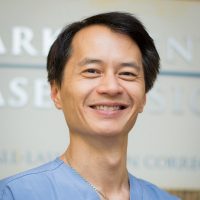
Guest editorial in the online journal EC Ophthalmology
Having been a refractive surgeon for 30 years and having performed over 30,000 procedures in that period of time, after getting my medical degree from Columbia Medical School, completing my residency at Harvard’s Massachusetts Eye and Ear Infirmary, and my Corneal Transplantation/Refractive Surgery Fellowship at Emory, I have enough experience to say that we refractive surgeons are doing a horrible job about explaining why people shouldn’t be wearing glasses and contacts anymore.
I had the pleasure of being certified on the first two excimer laser brands in the world, by the two ophthalmologists who invented refractive surgery. Steven Trokel certified me on the VISX laser, and Francis L’Esperance certified me on the Summit laser in the early 1990’s. Back then, in the dawn of refractive surgery, optometrists and opticians actually worried that the excimer laser was going to kill the contact lens and spectacle industry.
It hasn’t worked out that way. Collectively, we have been doing a horrible job of explaining to the lay public, and also to even other eye doctors, that refractive surgery is safer than long-term contact lens wear. I did my fellowship under Doyle Stulting, MD, PhD, Past President of the American Society of Cataract and Refractive Surgery (ASCRS). Doyle was the most scientific and rigorous of the many famous ophthalmologists that I had the pleasure of training under (and that includes his somewhat more famous colleague and co-fellowship Preceptor, George Waring II). During my fellowship, Doyle had me and the prior fellow, Keith Walter, help him run a statistical analysis of how safe refractive surgery was. We found that refractive surgery was so safe, that we could not logically counsel patients to do one eye at a time, because that would cause them to have to drive in twice as many times for their surgery and postop. visits, and the incremental increase in their risk of getting into a car accident exceeded the risk of infection after refractive surgery. We also found that the risk of vision loss from contact lens use over a decade was higher than the risk of refractive surgery. Why is that? Because most contact lens users sometimes wear lenses overnight, or don’t clean them properly, or “top off” their solutions instead of always using new solutions, or replace them less frequently than ideal, or wear them while swimming. taking a shower, or using a hot tub. And all of those things have been proven to vastly increase the chance of a severe infection causing permanent loss of vision. Unfortunately, we didn’t publish either of these analyses–but now, three decades later, I wish we had.
The vast majority of contact lens and eyeglass users have at least thought of getting refractive surgery, but most people do not pursue this further. We have done such a bad job of educating the public about the relative safety advantage of refractive surgery, that the candidate pool is increasing, rather than decreasing. More people newly need glasses or contacts every year then we are lasering.
We refractive surgeons haven’t helped our cause by some of our common practices. For example, the vast majority of ophthalmologists performing refractive surgery do not intentionally overcorrect the prescription when lasering young mypopes. Even among cornea fellowship-trained surgeons, a minority of surgeons do this. The result is that many people think that their prescription “came back” or that the effect “wore off”. They don’t realize that they, a 22-year-old -3.00 myope, for example, went to a surgeon who entered -3.00 into the laser–even though if asked, he or she would say that that patient would probably progress their myopia another -.50 or even -1.00 before they stabilized at age 30. I have had endless debates on KeraNet and other refractive surgeon message boards, arguing with my colleagues that they should add something to their nomogram to account for myopic progression. Commonly, the resistance is that they don’t know “exactly” how much more that patient will progress. But if we know they will progress, shouldn’t we at least add something? My answer is yes, and my practice looks at old prescriptions, racial/genetic factors, and even ask if the patient plans on going to graduate school, to come up with a better estimate of how much to overcorrect. But the vast majority of surgeons do none of this (and 90% of the surgeons performing LASIK never did a cornea fellowship like the one I precept through the San Francisco Match–they just take a 4 hour course).
Yes, advances like Smile have extremely fast recoveries, advances in ICL have expanded the upper limit for corrections to -20, and hardware and software upgrades, employing new techniques such as ray-tracing optimizations have the ability to correct many people to a UCVA exceeding 20/20. In my practice, if I can manifest the patient to better than 20/20, and their prescription is less than -3.00 or +2.00, most of these patients wind up seeing better than 20/20. The unfortunate truth is that most laypeople and most eye doctors who have not completed a Cornea/Refractive Fellowship don’t know that for low to moderate prescriptions, a common visual outcome is they see better afterwards than they ever saw in glasses or contacts.
I have been featured on CNN, ABC, NBC, CBS, Discovery Channel, the NY Times, The Wall Street Journal, and even things like the Howard Stern Show. You don’t get there by being run-of-the-mill. I was the first surgeon to laser someone with a UCVA of 20/20, who wanted to see better than 20/20–this was almost a decade ago, and the patient was my current Marketing Director, who wanted to be a “walking testimonial” so he could “sell” LASEK better (he wound up seeing 20/15 out of each eye and 20/10 with both eyes open after his Wavefront LASEK).
30 years ago, I was the 1st eye MD in NY to get LASIK himself. Five years ago, I became the first and only eye surgeon in the world to operate on himself! I performed an epi-LASEK on my non-dominant eye, rigging the epi-keratome and laser to be operated by my hands, rather than a foot pedal (with my friend and colleague Jon Ellant helping center the ablation), to demonstrate that the non-cutting LASEK is so safe, you can do it on yourself–try that with a LASIK or Smile!
I didn’t do these things primarily to gain notoriety or media attention or patients–although those were minor side-benefits. I primarily did these pioneering procedures on myself to prove to the general public that despite all the bad press that LASIK has gotten (e.g. patients relatives claiming that they committed suicide because of post-LASIK dry eyes, or a disgrunteled former FDA official saying if he had to do it over again, he wouldn’t have approved LASIK), refractive surgery is safer than cataract surgery, and not only the safest eye surgery procedure from a statistical point of view, but also can be considered the safest surgical procedure of any type (depending on the metrics assessed)
In summary, anyone thinking about getting refractive surgery should just choose a well-qualified, experienced, preferably Cornea Fellowship-Trained surgeon, and get it done. Remind your surgeon to overshoot you if you’re a young myope, and to show you monovision in the phoropter if you are over 45 years old. And eye doctors who don’t perform refractive surgery should stop opining about it to friends and family. My uncle is a retina surgeon at Harvard, and he won’t find me handing out retina surgery advice on the street corner. He (and all non-cornea trained ophthalmologists and all optometrists) should stop telling people at cocktail parties and their patients that LASIK “isn’t safe”–because that’s simply not true.
We would be doing ourselves and our patients a service if we stuck to the facts, so the world would understand that if they wish to be free from glasses and contacts, that “safety” isn’t a reason to hesitate. And neither are dry eyes, I am 100% sure that I can alleviate severe dry eye symptoms and visual distortions from every unhappy LASIK patient–but they would have to first come to me (and I do accept medical insurance)
Sincerely,
Emil Chynn, MD, MBA